



Infrastructural Opportunism: Mobility For All By All
Linda C. Samuels, Matthew Bernstine, and Penina Acayo
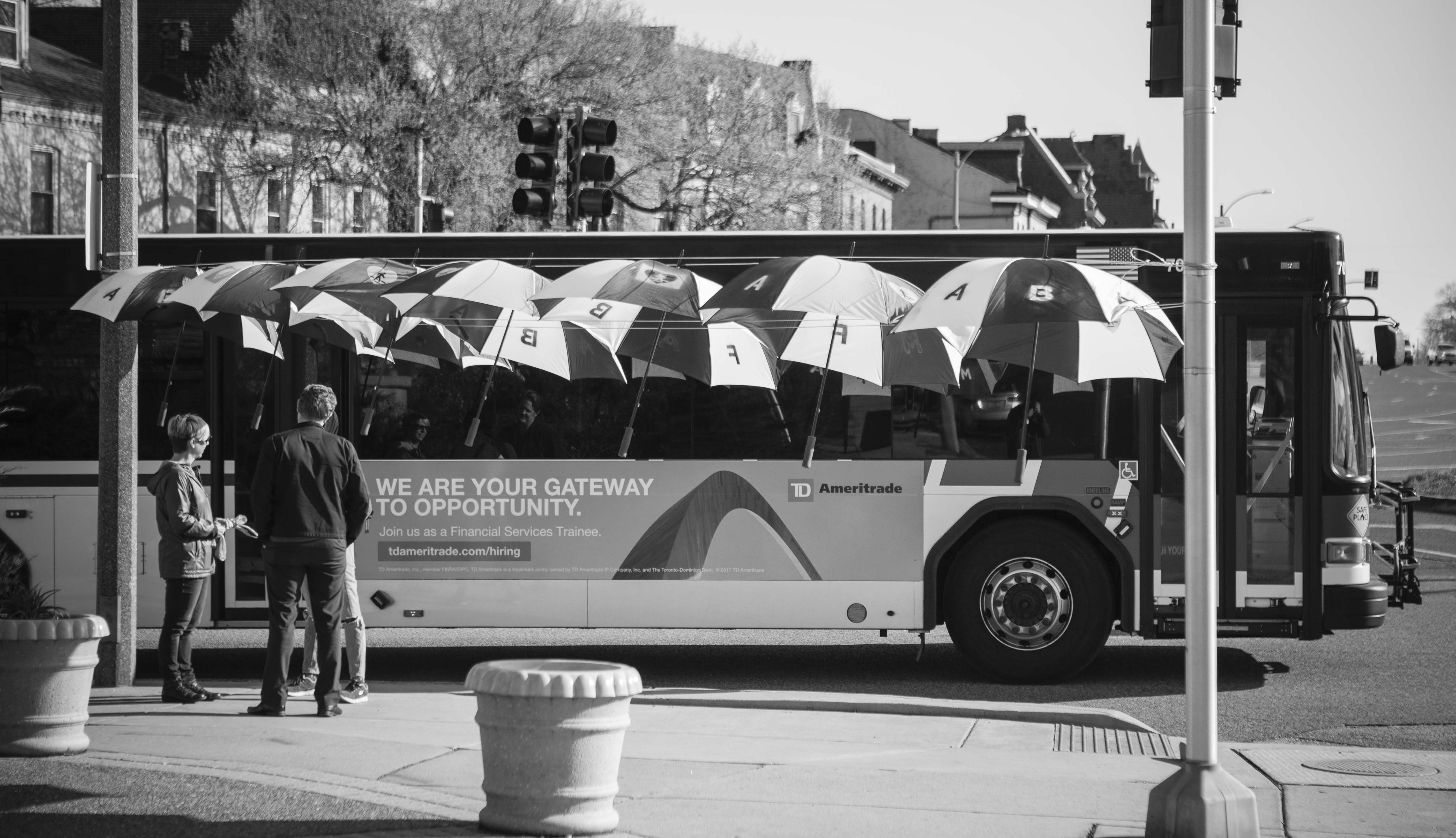
In the next decade the St. Louis region could spend over $2.2 billion on an expansion of its Metrolink system. Though multiple alignments are under consideration, the Northside/Southside route is purposefully intended to help stabilize and revitalize the most challenged neighborhoods in the St. Louis region while better connecting them to jobs and services. Once thriving areas, these neighborhoods now see declining population, degraded property conditions, high poverty rates, and some of the lowest car ownership rates in the city. This lack of literal mobility results in some of the longest commute times and greatest separation from amenities and necessities in the region. That literal lack of mobility, however, is symptomatic of a much more insipid and destructive economic and social stasis. Decades of displacement combined with disinvestment in neighborhood resources have resulted in a city where the access gap is as stark as the nearly twenty year gap in life expectancy, and where trust in developers and government agencies is deservedly low. This multi-billion dollar infrastructure investment has the potential to balance that gap, but not if the business as usual model of rewarding the white and wealthy and displacing and erasing the black and poor persists. Our interdisciplinary team of designers, writers, researchers, and activists are partnering with the Bi-state Development Research Institute and Citizens for Modern Transit to experiment with an arts and design-based approach to building community-centered ownership and broad vision around this enormous infusion of resources. Infrastructural Opportunism: Mobility For All By All is aimed at leveraging this investment for a “transit ++” system generated by the people of the neighborhoods with the aim of increasing equity and access for all.
INFRASTRUCTURAL OPPORTUNISM:
Mobility For All By All
In 2007 the City of St. Louis completed an 18-month, multi-million dollar study on possible route extensions to the current Metrolink rail system. The peak of the Great Recession the following year brought a halt to what seemed like non-essential infrastructural spending; the proposal failed to regain traction in the years immediately following. Outgoing Mayor Slay, however, has made the Northside/Southside line a top priority and new alignment studies have been undertaken by both the city and the county. This $2.2 billion project, if built, will be the largest infrastructural investment in the region for a generation. The next Mayor will inherit the question of transit’s future in St. Louis and determine which values guide that investment in conjunction with St. Louis County. The aim of Infrastructural Opportunism: Mobility For All By All is to bring together an interdisciplinary team of designers, GIS-experts, writers, researchers, and community activists in partnership with the Bi-state Development Research Institute (an arm of Metro) and Citizens For Modern Transit to collaborate with the impacted residents and envision not just a new billion dollar train, but an investment in uniting this divided city.
Ours is a three-part proposal: create and test a metrics system based on equity progress over economic development; establish interdisciplinary teams to engage residents around the three most challenged proposed station locations; develop and execute site-specific collaborative community projects (CCPs) with residents.
The project will run for the full 12-months of the grant, and possibly continue beyond if additional resources are secured. The schedule is well-aligned with city events including the upcoming city Mayoral election, the start of a new transit study, an overlap with the term of the new Resilient City Officer (tasked with setting critical objectives and key metrics), the planning of the NGA relocation to the study area, and an opportunity to capitalize on ongoing faculty teaching and research.
METRICS / Measuring Equity First
The success of a region is often measured by its rise in gross economic production. Cities make investments and provide incentives to spur economic development, but those do not reflect the true progress of a community or insure equitable distribution of gains and benefits. In this phase of the project the core team is partnering with two experts, Eric Zencey and Iris Patten, to develop and use frameworks that evaluate a broader range of progress indicators. Zencey’s strategy is called GPI +, or Genuine Progress Indicator Plus. GPI+, inspired by Bhutan’s happiness index among other alternative metrics, aims to recalibrate the measure of community success to focus on net economic wellbeing rather than simple dollar total of money spent. Iris Patten of the Geospatial Collaborative and ROGUE, INC (Realize Opportunities for Growth, Unity & Equity: Innovate New Capacities) uses readily available GIS tools to create resident-driven livability goals. The objective of ROGUE INC is to help citizens improve their quality of life by understanding and engaging the systems that control and impact their daily existence. Combined with our own expertise in sustainability measurement, we will work with Eric and Iris to develop a framework communities can use to create their own benchmarks that measure equity and well-being first.
In community engagement work, the process is critical and inseparable from determining the products; final deliverables cannot be legitimately set in advance but will emerge instead from the work throughout the year. Our process will occur through three avenues: utilizing existing coursework taught by the three core team members; testing the new metrics frameworks as outlined above; and direct engagement with community members in the three selected geographical areas to develop the collaborative community projects.
The core partners have identified opportunities in their existing coursework to incorporate the aims of the proposal (see workflow diagram for a specific list). Collectively, these courses reach a range of undergraduate and graduate students, both inside the Sam Fox School and across the University. All courses already incorporate research, outreach, and creative processes which will, for this year, be focused on the aims of this proposal.
The sites for the Collaborative Community Projects (CCPs) will be selected through the assessment of the social and spatial context of the proposed new Metrolink stops; each will have its own interdisciplinary team devoted to development, implementation, and evaluation. The teams nor the CCPs are pre-set and will emerge from the work done by the core team over the summer and in collaboration with partners and communities in the fall to best reach the goals of the overall project. CCPs may range anywhere from temporary structures to digital mapping to public performance as long as they meet the objectives of the larger project and the specific site team. The end goal is to create a collaborative outcome specific to each location, team and community that reflects the needs, values, and visions at that particular location. The community engagement process, the expertise of the partners and the set of equity metrics will help guide the content of the CCPs.
Each of the three projects will have a budget of $3000. The budget distribution will be determined by the team dedicated to that site under the guidance of the core team members. Events will be held throughout the year to collectively share and assess, across the sites and teams, the emerging results before making them publicly available.
AIMS
The ultimate aims of Infrastructural Opportunism: Mobility For All By All are: to develop and test alternative frameworks for measuring overall wellness and progress through an equity-plus rather than an economic-only lens; to collaborate with communities to develop accessible, resident-driven, data-based systems to effectively improve daily and long-term quality of life; to engage in interdisciplinary learning and teaching through existing coursework while expanding research opportunities for faculty; to work creatively across disciplines, demographics, and geographies in the development and production of site-specific collaborative projects; to widely share findings and results in open source format; and for members of the participating communities to develop voice and vision that ultimately impacts the planning and production of their changing neighborhoods.
Lastly, this project is intended as an instigator to more seriously and concretely explore the re-emergence of an interdisciplinary urban research lab focused on teaching, research and outreach both in St. Louis and other urban environments. Through this lab, significant work can be produced and archived to build a growing resource for advancing equitable design. A collective repository allows expertise to build on local and global conditions and supports Washington University’s reputation as a leader in interdisciplinary sustainability thinking.
Please visit the website for this project here.
Core Team
Matthew Bernstine, AICP, LEEDap is a lecturer & Senior Urban Designer in the Sam Fox School of Design & Visual Arts, College of Architecture / Graduate School of Architecture & Urban Design
Penina Acayo Laker is an Assistant Professor in the Sam Fox School of Design & Visual Arts Washington University in St. Louis, College of Art & Design
Linda Samuels, RA, PHD, is an Associate Professor in Urban Design in the Sam Fox School of Design & Visual Arts Washington University in St. Louis, College of Art & Design
Organizational partners:
Courtney Mueller, Vector Communications
Lisa Cagle, Bi-State Development
Liza Farr, Bi-State Development
Project partners:
Arias Bryan, Research Assistant, Master of Architecture/Master of Urban Design Candidate
Iris Patten, Program Director – GIS Collaborative, University of Arizona
Eric Zencey, Gund Fellow for Ecological Economics, University of Vermont
Rodrigo Reis, D.,Professor, Investigator at Prevention Research Center, Washington University in St. Louis
Antionette Carroll, Creative Reaction Lab
Erika Harano, Creative Reaction Lab
Sunni Hutton, Dutchtown South Community Corporation
Umeme Houston, Sewcial Impact Project
Alix Gerber, Visiting Assistant Professor in Communication Design